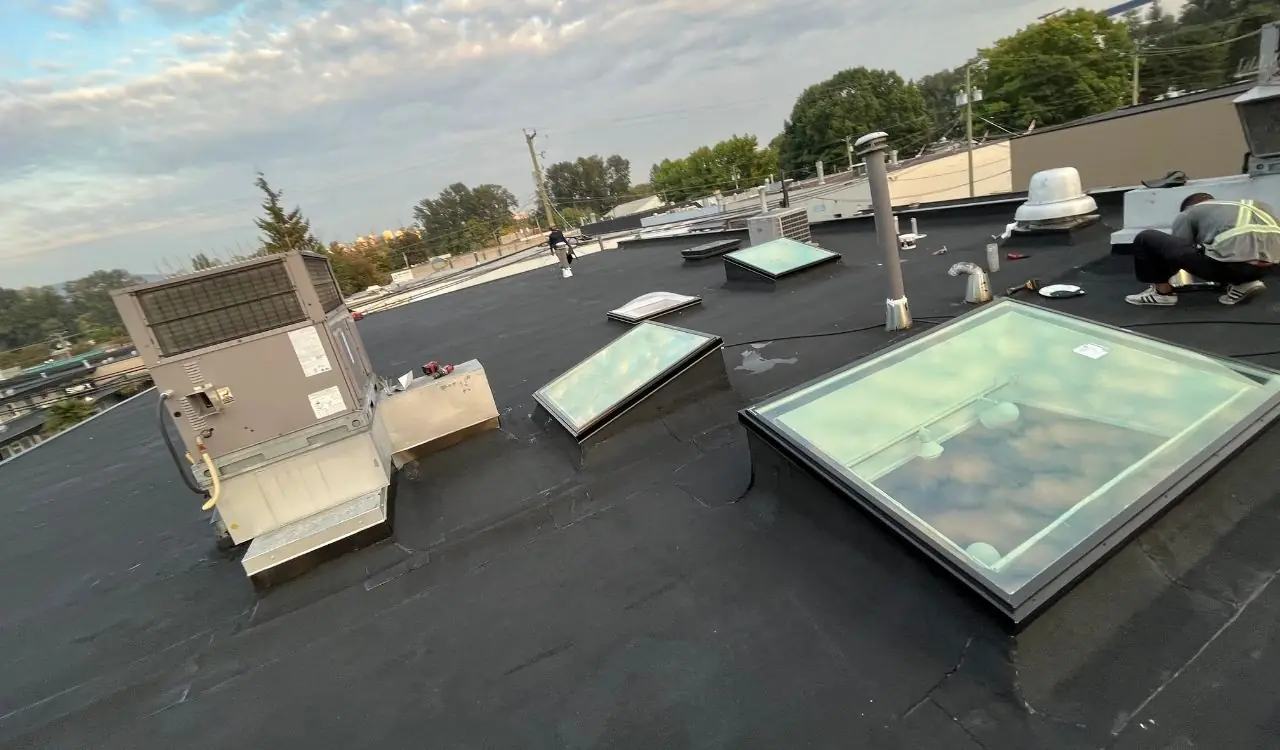
A flat roof is never truly flat. Every functioning low-slope roof is built with a slight pitch, just enough to move water toward drains, scuppers, or edge gutters. Because gravity does less of the work than it does on a pitched roof, flat roofing depends on continuous waterproof membranes rather than overlapping shingles or tiles. This guide describes the membrane systems in common use, how they are installed, and how they should be maintained. It is written as a general technical reference and cites industry standards bodies throughout.
What Counts as a "Flat" Roof?
Roofing practice divides roofs into two broad families by slope. Steep-slope roofs, generally 3:12 (three inches of rise per twelve inches of run) or steeper, shed water with overlapping materials such as shingles, shakes, tiles, or metal panels. Low-slope roofs fall below that threshold. What owners call a "flat" roof is therefore a low-slope roof, typically constructed at about 1/4 inch per foot of slope, the minimum most building codes and manufacturers require for positive drainage.
That small slope is not decorative. A perfectly level roof would hold water indefinitely, and standing water is the single greatest enemy of a flat roof. Everything about flat roof design, from tapered insulation layouts to drain placement, exists to keep water moving off the surface.
How Flat Roofs Handle Water
Three elements work together to manage water on a low-slope roof:
- Slope to drain. The roof deck or the insulation above it is sloped toward drainage points. Where the structure itself is level, tapered insulation panels are used to create falls, typically at 1/4 inch per foot, directing water to drains or scuppers.
- Drainage points. Interior roof drains connected to the building's plumbing, exterior scuppers through parapet walls, and edge gutters all serve the same purpose. Each drain serves a limited roof area, and overflow scuppers set slightly above the primary drains act as a backup if a drain clogs.
- The membrane itself. Unlike shingles, which shed water by overlap, a flat roof membrane is a continuous waterproof layer. Seams between sheets, flashings at edges and penetrations, and the membrane's own integrity are what stand between the weather and the building interior.
Ponding water deserves special attention. The industry generally defines ponding as water that remains on the roof 48 hours after rainfall ends under dry conditions. Occasional shallow ponding after a storm is normal; persistent ponding accelerates membrane aging, adds structural load, and in freeze-thaw climates can pry at seams as ice forms and melts. Persistent ponding usually points to a drainage or slope problem that should be corrected rather than simply lived with.
The Main Flat Roofing Systems
Six membrane families account for nearly all low-slope roofing installed today, plus one legacy system worth knowing about because so many older buildings still carry it.
Built-Up Roofing (BUR)
The oldest of the modern systems, built-up roofing alternates layers of bitumen (asphalt or coal-tar pitch) with reinforcing felts to create a finished membrane usually three to five plies thick, surfaced with gravel or a mineral cap sheet. A well-built BUR roof commonly lasts 20 to 30 years. Its strengths are redundancy (multiple waterproof layers) and a long track record; its drawbacks are weight, labor intensity, and the fumes and fire considerations of hot-applied bitumen. Gravel surfacing protects the bitumen from ultraviolet degradation but makes leak detection harder.
Modified Bitumen
Modified bitumen takes the BUR concept and factory-manufactures it into rolls: bitumen modified with polymers for flexibility and durability. Two polymer types dominate. APP (atactic polypropylene) membranes are typically torch-applied, the familiar "torch-on" method in which an open flame melts the bitumen underside as the roll is laid. SBS (styrene-butadiene-styrene) membranes are more flexible in cold weather and can be torch-applied, cold-adhered, or self-adhered. Modified bitumen roofs typically last 20 to 30 years and remain among the most common choices for residential and small commercial flat roofs.
EPDM (Ethylene Propylene Diene Monomer)
EPDM is a synthetic rubber membrane, usually black, supplied in large sheets that minimize seams. It can be fully adhered, mechanically fastened, or loose-laid and ballasted with stone. Seams are joined with tapes or liquid adhesives rather than heat. EPDM is known for durability and weather resistance, with service lives commonly reported at 25 to 30 years or more. Its dark surface absorbs heat, though white-coated versions and white EPDM products exist for reflectivity.
TPO (Thermoplastic Polyolefin)
TPO is a single-ply thermoplastic membrane, usually white, with seams heat-welded into a monolithic sheet. Its reflective surface reduces cooling loads, which made it popular for commercial buildings. Typical reported lifespans run 20 to 25 years, though as a comparatively newer material its very-long-term performance record is still being written. Early-generation TPO formulations had well-documented durability issues; current formulations are substantially improved, which is worth knowing when evaluating an older TPO roof.
PVC (Polyvinyl Chloride)
PVC is another heat-welded thermoplastic single-ply, with the longest track record of the thermoplastics in roofing. It resists chemicals, grease, and fire well, which is why it is common on restaurants and industrial buildings. Typical lifespans of 20 to 30 years are reported. PVC membranes require compatible accessories and cannot be installed directly over certain materials such as asphalt-based products without a separation layer.
Liquid-Applied Membranes
Liquid-applied systems, based on silicone, acrylic, polyurethane, or PMMA (polymethyl methacrylate) chemistries, are applied as a liquid that cures into a seamless membrane. They are widely used as restoration coatings over existing roofs, where they can extend service life at lower cost than a full replacement, and for detailing complex penetrations and flashings. Performance depends heavily on applied thickness and surface preparation; lifespans of 10 to 20 years are typical for coating systems, varying by chemistry and mil thickness. Because they conform to any shape, liquid systems are also the standard answer for waterproofing irregular details that sheet goods handle poorly.
A Note on Hypalon (CSPE)
Chlorosulfonated polyethylene, sold under the Hypalon trade name, was once a significant single-ply roofing material. Its manufacturer discontinued the polymer, and no new Hypalon roofing is produced. Many older buildings still carry Hypalon roofs; when they reach end of life they are generally replaced with TPO, PVC, or another current system. Liquid coatings are sometimes used to extend a sound Hypalon roof, but replacement is the usual long-term answer.
Comparing the Systems
| System | Typical lifespan | Common installation methods | Notable strengths |
|---|---|---|---|
| Built-up roofing (BUR) | 20-30 years | Hot-mopped, cold-applied | Redundant multi-ply protection; long track record |
| Modified bitumen | 20-30 years | Torch-applied, cold adhesive, self-adhered | Tough and repairable; good for residential scale |
| EPDM | 25-30+ years | Fully adhered, mechanically fastened, ballasted | Proven longevity; large sheets mean fewer seams |
| TPO | 20-25 years | Heat-welded; adhered or mechanically fastened | Reflective white surface; welded seams |
| PVC | 20-30 years | Heat-welded; adhered or mechanically fastened | Chemical and grease resistance; welded seams |
| Liquid-applied | 10-20 years | Roller, spray, or squeegee | Seamless; ideal for restoration and complex details |
Lifespans are industry-typical ranges for properly installed and maintained systems; actual performance varies with climate, installation quality, and maintenance.
How the Membranes Are Installed
Installation methods cut across the membrane families:
- Torch-applied: an open flame melts the bitumen underside of modified bitumen rolls. Fast and reliable in trained hands; requires strict fire-safety protocols.
- Hot-mopped asphalt: hot bitumen mops felts into place in BUR systems. Fumes and burn hazards limit where it can be used.
- Cold adhesive: modified bitumen or felts set in cold-applied adhesives. No flame, at the cost of longer cure times and weather sensitivity during installation.
- Self-adhered: peel-and-stick modified bitumen membranes. Clean and flame-free; substrate preparation is critical.
- Heat-welded: hot-air welders fuse TPO and PVC seams into one continuous sheet. Weld quality is testable on site by probing cooled seams.
- Fully adhered: membranes glued to the substrate with bonding adhesive, common for EPDM, TPO, and PVC.
- Mechanically fastened: plates and fasteners secure the membrane, typically with the next sheet's seam welded or taped over the fasteners.
- Ballasted: loose-laid membrane held down by stone ballast or pavers. Simple and inexpensive; heavy, and leak detection is difficult under ballast.
Flashings: Where Most Leaks Begin
Roofing professionals widely observe that most flat roof leaks originate not in the open field of the membrane but at flashings: the transitions where the roof meets walls, parapets, curbs, vents, skylights, drains, and edges. Flashing details must accommodate building movement, thermal expansion, and water flow simultaneously, which makes them the most demanding part of any flat roof. When evaluating a roof's condition, or a contractor's proposal, the flashing details deserve more scrutiny than the choice of field membrane. A mid-grade membrane with excellent flashing work will outperform a premium membrane with poor details.
Maintaining a Flat Roof
A maintenance program is the difference between a roof that reaches its full lifespan and one replaced a decade early. The program below reflects standard industry practice.
Inspect twice a year, plus after severe weather
Spring and fall inspections catch winter damage before the wet season and summer damage before winter. After windstorms, hail, or unusually heavy rain, an additional check is warranted. Inspections should cover the membrane surface, all seams, flashings, penetrations, drains, scuppers, gutters, and edge metal.
Keep water moving
Clear drains, scuppers, and gutters of leaves and debris. Verify that water actually leaves the roof during rain rather than collecting. Note any ponding that persists beyond 48 hours after rainfall and have its cause investigated; the fix may be as simple as clearing a drain or as involved as adding tapered insulation or an additional drain.
Check seams, flashings, and penetrations
Look for open or lifting seams, cracked or separated flashing, deteriorated sealant, and damaged pitch pans or pipe boots. On heat-welded systems, seams can be probed gently; on adhered systems, look for edge lift. Sealant is a maintenance item, not a permanent waterproofing solution: it should be renewed on schedule, not relied upon to rescue failed flashing.
Manage foot traffic
Limit roof access to those who need it, use designated walkways or walk pads to service equipment, and never drag equipment across the membrane. A large share of premature membrane damage comes from service technicians servicing HVAC units, not from weather.
Control vegetation and debris
Remove leaves, branches, and windblown debris that trap moisture against the membrane. Pull seedlings and vegetation promptly; roots exploit the smallest openings. Trim overhanging branches that drop debris or abrade the surface.
Keep records
Photograph the roof's condition at each inspection, note the locations of any repairs, and keep warranties and contractor reports in one file. A documented maintenance history supports warranty claims and gives any future contractor an accurate picture of the roof's life.
Common Problems and Their Causes
- Blisters: raised bubbles in bituminous membranes, usually from trapped moisture or air expanding in heat. Small, intact blisters are often monitored; large or broken ones need repair.
- Ridging: long raised ridges in bituminous systems, typically from moisture in the insulation or felts.
- Alligatoring: a pattern of small cracks resembling alligator skin on aging asphalt surfaces, indicating the bitumen has lost its oils to UV and weather. Surface coatings can extend service; advanced alligatoring means replacement is approaching.
- Ponding: persistent standing water from inadequate slope, settled insulation, or blocked drainage.
- Seam failure: open laps from poor installation, adhesive breakdown, or thermal cycling.
- Flashing failure: separation or cracking at walls, curbs, and penetrations, the most common leak source.
- Punctures and cuts: from foot traffic, dropped tools, or windblown debris. Single-ply membranes are more puncture-prone than multi-ply BUR.
- Shrinkage: EPDM in particular can shrink over decades, stressing flashings and pulling at edges; modern installations use detailing designed to accommodate it.
Repair or Replace?
Localized damage on a membrane with substantial remaining life is usually repairable: patches, re-welded seams, renewed flashing, and recoating can all be cost-effective. Replacement becomes the rational choice when problems are widespread (extensive blistering, alligatoring across large areas, saturated insulation), when the membrane is past its typical lifespan, or when repeated repairs in the same areas indicate systemic failure. Moisture surveys, using infrared thermography or capacitance meters, can map wet insulation and quantify how much of the roof is compromised, which turns the repair-versus-replace decision from guesswork into measurement.
Choosing a System
No single system is best for every roof. The practical selection factors are:
- Building use: restaurants and industrial facilities favor chemical-resistant PVC; large warehouses often use economical TPO or EPDM; residential flat roofs commonly use modified bitumen.
- Climate: freeze-thaw cycling rewards flexible membranes and robust flashing; hot climates reward reflective surfaces; high-wind regions need mechanically robust attachment.
- Foot traffic: roofs with regular equipment servicing need puncture-resistant systems and walkway protection.
- Budget horizon: liquid-applied restoration can defer replacement at lower upfront cost; a full membrane replacement costs more but resets the clock.
- Installer expertise: every system fails when installed poorly. A contractor's demonstrated experience with the specific system matters at least as much as the material choice.
References
- National Roofing Contractors Association (NRCA). The NRCA Roofing Manual: Membrane Roof Systems. nrca.net
- ASTM International. Standard specifications for SBS-modified bituminous sheet materials (ASTM D6162, D6163, D6164); APP-modified bituminous sheet materials (ASTM D6222, D6223); EPDM sheet (ASTM D4637); TPO sheet (ASTM D6878); PVC sheet (ASTM D4434). astm.org
- Canadian Roofing Contractors Association (CRCA). Roofing reference materials. roofingcanada.com
- Whole Building Design Guide (WBDG), National Institute of Building Sciences. "Low-Slope Roofing" sections. wbdg.org
- Single Ply Roofing Industry (SPRI). Technical bulletins on thermoplastic and thermoset single-ply systems. spri.org
About this guide. This reference is published by Scarlet Roofing & Gutters as a public information resource. It is intentionally non-promotional: it contains no pricing, no service offers, and no calls to action. Corrections and suggestions from roofing professionals are welcome at info@scarletconstruction.ca.